Recenzia zatiaľ nie je preložená — zobrazujeme pôvodné znenie (English).
Sometimes all you need is a handful of marbles and an empty board. Chain Reaction is proof that the best logic games don't need to be flashy — they just need to work flawlessly. A nineties puzzle from an era when developers didn't need to mess with 3D graphics because they knew the player's brain was the best graphics engine in the world.

You play on a grid of squares. At the start, a marble drops that you place anywhere on the board. If more marbles of the same color fit in the same row or column, they form a chain and disappear. The longer the chain, the more points. Here's the critical twist: the moment you place a marble, five more appear randomly on the board. Chain Reaction's power lies precisely in this pressure — it's not passive puzzle-solving, it's about prediction and panic.
The controls are primitive in the best sense of the word. You use the mouse cursor to pick a spot, click, and the marble falls. You activate chain shifts the same way. The graphics are standard DOS fare — pixelated, plain, precise. The sounds are low-fidelity but effective: the crunch when marbles vanish is quite satisfying. The game's pace constantly accelerates, the board fills up, and you're trying to calculate three moves ahead while time doesn't really exist.
The nineties loved logic games without armor — Tetris, Columns, Puyo Puyo. Chain Reaction is their descendant, carrying forward the most important gene: obsession. It's not a game you play for half an hour. It's a game your brain plays for another half hour after you close it. It aged gracefully because it never wanted to be modern in the first place.

Playing it today means returning to a time when computer games didn't con players with timers and paywalls. Chain Reaction doesn't nag you, doesn't force you to wait, and doesn't know what a tutorial is. Either be clever, or drown in marbles. Simple and elegant.
 old
old ▶The Price is Right1990MS-DOS / PC
 ▶Captain Blood1988MS-DOS / PC


 ▶Tel-Tel Mahjong1990Sega Mega Drive


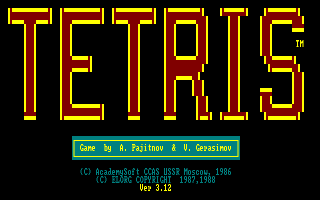 ▶Tetris1985MS-DOS / PC
 ▶Boulder Dash1984MS-DOS / PC

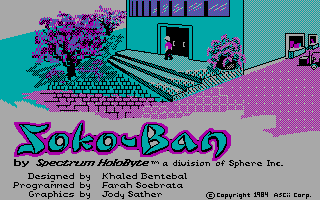 ▶Sokoban1984MS-DOS / PC
 ▶Teenage Queen1988MS-DOS / PC
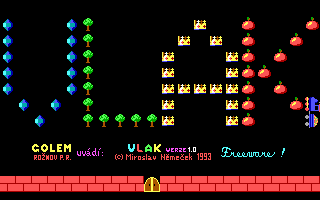 ▶Vlak1993MS-DOS / PC
