Этот обзор ещё не переведён — показываем оригинал (English).
Ultimate Cards. A title that promises absoluteness. The ultimate card game. The alpha and omega of everything ever played with a deck of 52 cards. Back in 1992, I'd sit through similar titles with one hand on the mouse and the other wrapped around a glass of cola, because there was no time for anything else — the break between homework lasted exactly as long as it took for the graphics sprites to load.
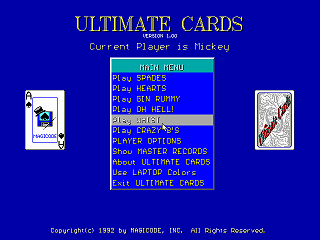
Genre-wise, the game positions itself as a platformer, which might sound like a typo for a card title. But as an old note suggests, Ultimate Cards apparently chose a less conventional path and instead of standard poker or solitaire, it bet on more eccentric card variants. I couldn't safely verify the exact set of games, so I'll be honest: I only know the details from what the title left behind in memory and in archives.
Playability in compilations like this from that era rises and falls with how well the developers understood that the interface is half the game. In 1992, it wasn't yet obvious that clicking a card would do exactly what you expected. Sometimes you had to grab the card, other times you just needed to press a number on the keyboard. The resulting experience varied wildly from title to title. If Ultimate Cards really did bet on less traditional games, it was either a bold move or a path to frustration — it depended on whether the author explained the rules or just assumed the player knew them from childhood visits to grandma's.
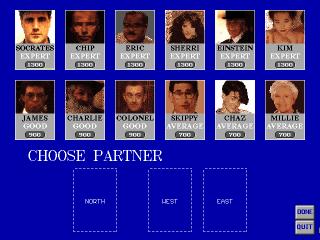
What similar titles from the MS-DOS era had going for them was time. Card games in 1992 didn't have to compete for attention with polygonal worlds or explosive soundtracks. A clean game principle was enough, tolerable graphics in four EGA colors or already decent 256-color VGA, and at least acceptable animation of flipping a card off the table. They aged well — or rather, didn't age at all, because the rules of card games never change. What aged was the interface, and sometimes cruelly.
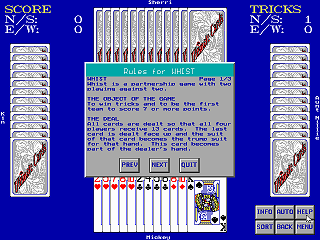
Today, Ultimate Cards suits anyone who wants to recall what playing on a computer looked like before every little thing became a million-dollar project. Or someone who wants to try a card variant you won't find in today's offerings. It runs in your browser without installation, without drivers, and without remembering where you left the boot disk. That's actually the biggest advantage of the entire DOS gaming era in 2024.
 old
old


 ▶Hugo 31995MS-DOS / PC


 ▶Commander Keen 4: Secret of the Oracle1991MS-DOS / PC
 ▶Giana Sisters1987MS-DOS / PC


 ▶Sonic The Hedgehog 21992Sega Mega Drive
 ▶Super Mario 64 MS-DOS Port2020MS-DOS / PC
 ▶Tiny Toon Adventures: Buster's Hidden Treasure1993Sega Mega Drive
 ▶Ghouls 'n Ghosts1988Sega Mega Drive

 ▶Mario DOS Demo1994MS-DOS / PC