Этот обзор ещё не переведён — показываем оригинал (English).
Midnight, a dark room, a blinking DOS prompt, and a sound that isn't really a sound — more like noise from a speaker. This is how your encounter with Castle of Kroz begins, a dungeoncrawler that with its ASCII characters and simple logic could have been finished back in 1985, yet manages to captivate you regardless.

It's a classic exploration crawler with a top-down view where you navigate chaotic labyrinths filled with creatures and obstacles. The goal is to venture through dungeons, collect items, open doors, and gradually descend deeper. Although the game lacks a story in the modern sense, it has that authentic retro punk atmosphere — after all, it was freely distributed as shareware and the creators didn't bother with flashiness.
The controls are straightforward: arrow keys to move, individual keys for interaction. Encounters with creatures aren't in real-time; instead, it behaves like turn-based strategy where you and enemies take turns. This occasionally feels oddly awkward — there's no text at all, no translations needed, everything is communicated through symbols and graphical logic. After you've puzzled over what each icon means for a few minutes, suddenly it clicks and you start understanding everything without instructions.
Castle of Kroz is probably best known for its difficulty and repetitiveness. The mazes often feel unnecessarily long, enemies are predictable, and they'll quickly drain your health. There's no safe haven you can leave without fear of losing progress — the game forces you to be careful, or die. This is exactly what makes it fascinating for those who enjoy old roguelikes with genuine challenge.
Today it's mainly a curiosity for retro enthusiasts and those who want to experience how games played without save points and only one life chance. Castle of Kroz in a browser certainly doesn't come across as an engaging game at first glance — it looks rather grim. Only when you push into the second level and feel that peculiar kind of frustration that draws us to such games do you understand why someone remembers it after thirty years.
 old


 ▶Dungeon Master1989MS-DOS / PC


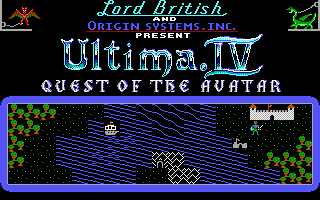 ▶Ultima IV - Quest of the Avatar1985MS-DOS / PC


 ▶Doraemon: Giga Zombie no Gyakushuu1990Nintendo NES
 ▶Light Crusader1995Sega Mega Drive
 ▶Phantasy Star IV1993Sega Mega Drive


 ▶Fallout 1 Prototype1997MS-DOS / PC
