이 리뷰는 아직 번역되지 않았습니다 — 원문(English)을 표시합니다.
1985. On one side, Marvel prints comics by the millions, on the other, Adventure International releases a text adventure about Spider-Man, where New York's greatest hero stands in a room waiting for someone to type him a command. This combination could have gone many ways.
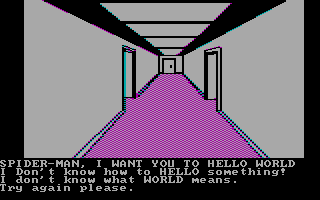
Questprobe Featuring Spider-Man is the second installment of a planned series that was supposed to cover the entire Marvel universe — before Adventure International went bankrupt and the project stalled somewhere around the third title. In this game you play as Peter Parker, aka Spider-Man, trapped in a building with no obvious way out. The elevator doesn't work, the stairs are missing, and you've got web-slinging, superhuman strength, and... a 1985 parser.
And that's where it gets both interesting and frustrating. The game combines text with simple static images — a decent presentation for the time, more of a historical curiosity today. Web-slinging as a game mechanic actually works here; Spider-Man can move in ways that wouldn't make sense in a pure text adventure, and the game makes use of that. The problem is the parser: the vocabulary is limited, puzzle logic sometimes jumps the rails, and the correct solution sometimes depends on guessing exactly the combination of words the designer had in mind. Anyone who's experienced Scott Adams — and Adventure International is his company, after all — knows what I'm talking about.
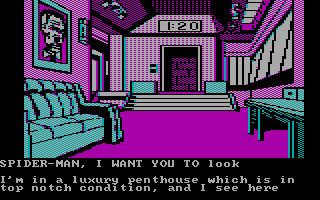
What I remember from when I first saw this game is the feeling that a superhero in a text adventure just doesn't quite work the way they should. Spider-Man is action, speed, movement. A text parser stops him dead and makes him think. Paradoxically, that might actually appeal to someone — it's more of a puzzle game in a comic book coat than an action affair. The graphics are modest, but acceptable for 1985 and a PC port. No music, minimal sound — that was standard for Adams.
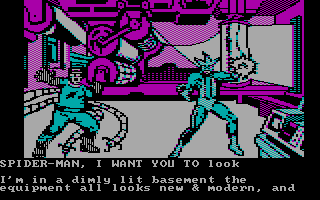
Today you can play this game in your browser via DOSBox emulators and it'll appeal to those who love early text adventures and take the comic book context as a bonus, not the main reason to play. Expect a short experience — the game isn't long — but with a few moments where a correctly typed command really gives you the feeling that you figured it out yourself. That's the foundation of the genre and this game holds that foundation. The rest is mostly a document of its time.
 old
old


 ▶Amazing Spider-Man1989MS-DOS / PC


