Ova recenzija još nije prevedena — prikazujemo izvornik (English).
The year is 1989, it's sweltering hot, summer vacation, and I'm sitting at the monitor desperately dragging pipe pieces across a grid while water relentlessly rises. I won't make it. I'll never make it. And yet I'll try again.

Pipe Mania originally came out under the LucasFilm Games banner — yes, the folks who gave us Maniac Mansion and Zak McKracken. The European version was then published by British outfit The Assembly Line. Genre-wise, it's pure puzzle gaming without story and without apologies: you get a grid, a supply of random pipe pieces, and a timer that starts ticking the moment water begins its journey. Your job is to build a route long enough for the water to flow through without spilling into empty space.
The game loop is simple and brutal at once. Pipe pieces arrive in your supply and you have no choice — you take what you get. A straight section when you need a corner. A corner when you need holes in both directions. The longer you last, the faster the water flows and the less time you have to think. Stress creeps in slowly, then all at once. The controls are dead simple, mouse or keyboard, no mysterious button combos — complexity comes purely from randomness and time pressure.
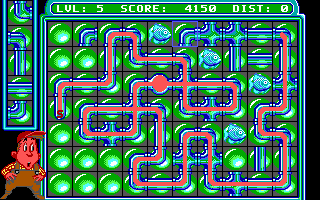
Even for 1989, the graphics were functional rather than captivating — gray grid, colorful pipe pieces, yellow fluid. Nobody minded back then, because the game grabbed attention in other ways entirely. Pipe Mania's addictiveness is almost suspiciously high: each round lasts a few minutes, the end comes suddenly, and the reflex of "one more time" kicks in automatically. The game mechanics were copied in various forms throughout the nineties and honestly still are today — like the minigame in BioShock for hacking, solved in exactly the same way. That fact alone says more than any review ever could.
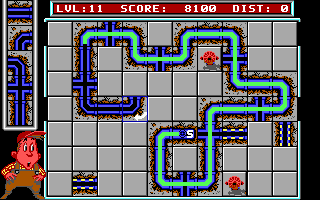
Today you can play Pipe Mania in your browser without installation and without tweaking SoundBlaster settings, for which I'm genuinely grateful. It suits anyone who's got ten minutes and wants to engage both hands and head at once. If the fact that the game looks like nothing more than what it actually is bothers you, look elsewhere. If you enjoyed, say, the Tetris-like logic of stack management and the pressure of quick decisions, you'll find more than enough reasons to pull up a chair.
 old
old


 ▶Tetris1985MS-DOS / PC

 ▶Boulder Dash1984MS-DOS / PC
 ▶Teenage Queen1988MS-DOS / PC

 ▶Sokoban1984MS-DOS / PC
 ▶Vlak1993MS-DOS / PC
 ▶Supaplex1991MS-DOS / PC

 ▶Boulder Dash III1986ZX Spectrum
 ▶Chess1998Sega Mega Drive


