Billiards on a computer. Plain and simple. There's no story, no campaign, no character keeping you company. Just you, your opponent (or the computer) and a green felt with four pockets in each corner.
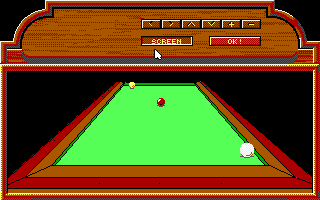
Billiards Simulator is a billiards simulator from 1989 for PC under DOS. You choose the rules, table dimensions, game mode — singles, American pool, three-cushion. The game calculates trajectories, angles, friction, energy. The graphics are minimalist: top-down view, the cue moves across a crosshair, balls roll according to physics that the developers pulled off surprisingly well. You control shot power, approach angle, spin on the ball. You don't need anything else.
And that's both the problem and the magic at once. The game is mathematically correct, but visually it's the simplest possible solution. There's no drama, no suspense, not even a loud "clink" when a ball drops into a pocket. I play three matches in a row and it stops being fun, because all that's left is stereotype — watching you miss twenty times in a row and waiting for your turn. The computer isn't a fun opponent; it's just an algorithm that behaves mechanically without improvisation or style.
Billiards Simulator has absolute functional accuracy, which makes it more of a tool than a game. Back in the '80s and '90s, it was interesting — proving that a computer could simulate billiards physics. Today, when we have 3D pool with all the bells and whistles, it's a musty artifact. Definitely not bad, but dry as a sugar cube.
Playing it today is only worth it for historical reasons or if billiards fascinates you as a physical phenomenon more than as entertainment. In a browser you've got five minutes for it; then you'll miss something that would make you want to keep going.
 old
old


 ▶Sensible World of Soccer 2016/20172016MS-DOS / PC


 ▶European Club Soccer1993Sega Mega Drive


 ▶The Manager1991MS-DOS / PC
