این نقد هنوز ترجمه نشده است — متن اصلی (English) را نشان میدهیم.
Most Spectrum games from 1995 were either nostalgia plays or forgotten curiosities. Zen Quest manages to be both at once—a puzzle game so understated that it barely registers as a blip in the platform's history, yet distinctive enough to stick with you once you actually sit down with it.

The premise is deceptively simple. You control a character navigating grid-based puzzles where the goal isn't to rush or shoot anything, but to figure out the logical sequence of moves that gets you from point A to point B. Each level presents a small, self-contained problem. No timers. No bosses. No dramatic music escalating your cortisol. Just you, the grid, and the creeping realization that you've been staring at the same room for ten minutes because you moved one square in the wrong direction three moves ago.
The controls are minimal—directional input, that's it. Holding down a direction moves you tile by tile. There's no fluidity here, no arcade rhythm. Every movement matters because every movement is deliberate. That's either the game's greatest strength or its most exhausting limitation, depending on whether you came to the Spectrum expecting reflex-based action or cerebral resistance. Zen Quest doesn't compromise. It commits to the idea that thinking is the mechanic, and movement is just how you externalize that thought.

What's remarkable isn't that this exists, but that it existed on hardware people used for Jet Set Willy and Manic Miner. The early nineties saw the Spectrum treated like a living relic—developers were still wringing games out of it while the industry had moved on. Zen Quest feels like a deliberate middle finger to that frantic energy. It's not trying to compete. It's ignoring the competition entirely.
By today's standards, it's almost austere. No narrative, minimal feedback, zero hand-holding. The puzzles scale in difficulty without explanation. Some levels click immediately. Others will have you wandering in circles until you stumble into the solution and wonder why it took you so long to see it. That's the point, actually—the frustration and the relief are the same sensation, just separated by the moment of understanding.

If you want a window into what someone could do with 48K of RAM and genuine indifference to commercial appeal, Zen Quest is there. It won't make you love the Spectrum. It might not even make you enjoy it. But it will make you think, and on a platform drowning in arcade clones, that alone makes it worth the thirty minutes it takes to get through a handful of levels in an emulator.
 old
old ▶Boulder Dash III1986ZX Spectrum
 ▶Animated Strip Poker1985ZX Spectrum
 ▶Boulder Dash VI1992ZX Spectrum
 ▶Strip Black-Jack1986ZX Spectrum
 ▶Strip Game1988ZX Spectrum
 ▶Makao1985ZX Spectrum
 ▶Spectrum Scramble1982ZX Spectrum
 ▶Boulder Dash V1992ZX Spectrum
 ▶Critical Mass1985ZX Spectrum
 ▶Earth Shaker1990ZX Spectrum


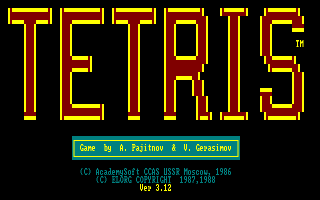 ▶Tetris1985MS-DOS / PC

 ▶Boulder Dash1984MS-DOS / PC
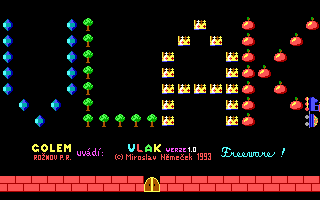 ▶Vlak1993MS-DOS / PC
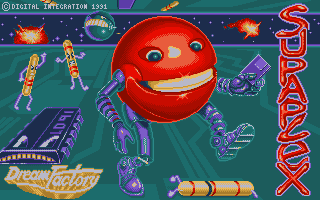 ▶Supaplex1991MS-DOS / PC