این نقد هنوز ترجمه نشده است — متن اصلی (English) را نشان میدهیم.
There's a particular kind of game that haunted every pirate cassette box in the eighties — the one nobody could quite explain, yet everyone knew existed. Spectrum Scramble is exactly that phantom title, a puzzle game for the ZX Spectrum that sits uncomfortably between sliding-block puzzles and some half-baked logic exercise, as if the programmer forgot midway through why he was making it.

You're looking at a deceptively simple premise: arrange coloured blocks or tiles into a target pattern within a grid. The screen fills with geometric shapes in that distinctive Spectrum palette—harsh reds, blues, and yellows that burn into your retinas after ten minutes. Your job is to slide them into the correct positions. No timer hammering your nerves, no elaborate storyline. Just you, the grid, and the gnawing sense that you're solving something the designer himself wasn't entirely sure about.
The mechanical core works fine for what it is. You navigate with the keyboard—responsiveness is adequate, which on the Spectrum meant the game didn't actively fight you. Each puzzle presents a new configuration, and the difficulty curve is about as gentle as these things come. But here's the catch: the puzzles themselves feel anonymous, like they were generated by someone following a formula rather than crafted with any real intention. You solve one, feel nothing, move to the next. The game doesn't build momentum or surprise you. It just sits there, methodical and hollow.

What makes Spectrum Scramble oddly memorable isn't that it's good—it isn't—but that it exists in that murky space between competence and purposelessness. It does nothing wrong enough to infuriate you, yet nothing right enough to justify the effort. The Spectrum's technical limitations are irrelevant here; this isn't a game hampered by hardware. It's a game that seems unsure of its own reason for existing, and that uncertainty seeps into every puzzle.

Today, it survives mainly as a footnote, something you'd encounter in a "complete Spectrum collection" alongside dozens of other forgotten titles. It's not worth hunting down, but if you find yourself in an emulator's darkened library and curiosity gets the better of you, twenty minutes won't hurt. You'll solve a few grids, feel nothing in particular, and move on to something with actual character. That's probably exactly what the programmer expected you to do.
 old
old ▶Boulder Dash III1986ZX Spectrum
 ▶Animated Strip Poker1985ZX Spectrum
 ▶Boulder Dash VI1992ZX Spectrum
 ▶Strip Black-Jack1986ZX Spectrum
 ▶Strip Game1988ZX Spectrum
 ▶Makao1985ZX Spectrum
 ▶Boulder Dash V1992ZX Spectrum
 ▶Critical Mass1985ZX Spectrum
 ▶Earth Shaker1990ZX Spectrum
 ▶Atomix II - Hexagonia1991ZX Spectrum


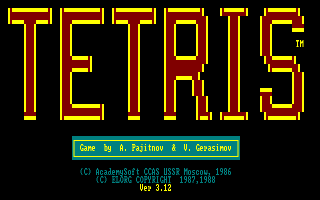 ▶Tetris1985MS-DOS / PC

 ▶Boulder Dash1984MS-DOS / PC
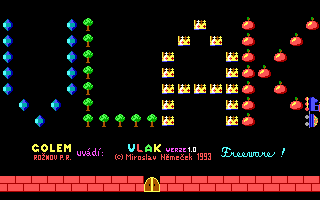 ▶Vlak1993MS-DOS / PC
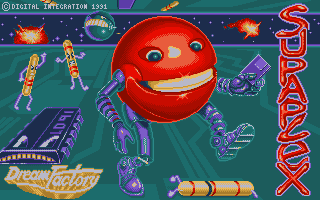 ▶Supaplex1991MS-DOS / PC