این نقد هنوز ترجمه نشده است — متن اصلی (English) را نشان میدهیم.
Year 1991, fresh revolution outside the window and I'm sitting over a Hercules monitor that's about as colorful as I am mature. On the diskette is L'Empereur from KOEI — the Japanese company that was supplying PC strategy games about history with diligence all their own during that era. Napoleon the Japanese way. It sounded odd. It was addictive.
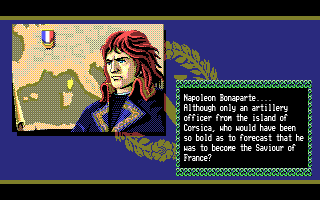
L'Empereur is a historical turn-based strategy set in the Napoleonic era. The player takes on the role of Bonaparte, starts with limited forces and gradually builds military and political power with the goal of controlling Europe. KOEI had similar titles under their belt from Chinese and Japanese history, and this was their attempt to transplant the proven recipe into a European context. The result was — let's say — a refined translation.
The game combines a diplomatic and military layer. You manage provinces, negotiate alliances, recruit armies and then march into battle. Key to it all, as the old note suggests: frontal assault leads to defeat. Artillery must prepare the breakthrough, infantry advances at the right moment, cavalry hits the exhausted flank. The tactical layer is notably simpler than, say, Struggle for Rome or later European grand strategy games, but in 1991 nobody complained about that. The interface is typically KOEI — stern menus with numerical choices, no dragging and dropping. You can control it, getting used to it takes an afternoon.
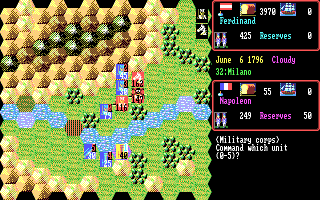
What KOEI did incomparably was create the feeling that behind every general stands a real person with statistics. Loyalty, charisma, military skill — numerical values that told a story without a single word of text. I wrote them down in a notebook back then, because I couldn't save them and losing a good commander felt like a personal tragedy. Today the game has aged visibly — the graphics are functional, not beautiful, and the pace is slow in a way that the modern player will most likely describe with a word you can't print in a family magazine.

L'Empereur suits anyone who wants to reach for KOEI in their golden age and doesn't mind that historical authenticity is more of an inspirational framework than a commitment. It runs flawlessly in a browser via DOSBox, saving and loading is easy — and that's an advantage that wasn't taken for granted in 1991. If Napoleonic themes appeal to you and you enjoy reading the right combination of numbers the way others read a novel, this is your evening.
 old
old


 ▶Ancient Art of War1984MS-DOS / PC

 ▶Battle Bugs1994MS-DOS / PC


 ▶Boppin1994MS-DOS / PC


