این نقد هنوز ترجمه نشده است — متن اصلی (English) را نشان میدهیم.
Year 1991, late afternoon, a monitor in the old man's office next door. A green table on the screen, a white ball and silence interrupted by keyboard clicks. Jimmy White's Whirlwind Snooker — a name like an exclamation, a game like a mysteriously soothing affair.
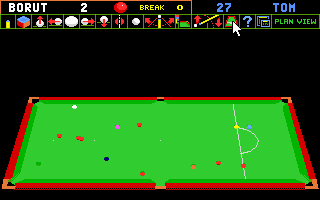
Virgin Interactive released a snooker sports simulation named after the hugely popular British player Jimmy White at the time. Snooker, for the uninitiated, is a cue sport played on a large table with fifteen red balls and a set of colored ones — and the rules are exactly as complicated as they sound. But the game doesn't try too hard to explain the rules; it just throws you at the table.
You can play either against another player or against the computer on four difficulty levels. And here's the thing: on lower difficulties the computer opponent makes mistakes, on higher ones it starts playing proper snooker — meaning it deliberately hides the white ball to get you into trouble. That wasn't a given in 1991. Control is keyboard-based, you aim, adjust shot power, choose spin. It's not simple, but surprisingly it works. Ball physics isn't perfect — that would be overselling it — but for the time it's acceptable and the gameplay stands on it.

What I remember most about this game is paradoxically the silence. No sound design overwhelms you. Green surface, white ball and you figure out where to send it. The game makes you think harder than you'd expect from a 1991 title. Visually today it looks like an Excel spreadsheet surrounded by colored dots — I'm not deluding myself. But mechanically the game loop holds. You plan a sequence, mess up one shot, watch your opponent sink four reds in a row. Classic stuff.
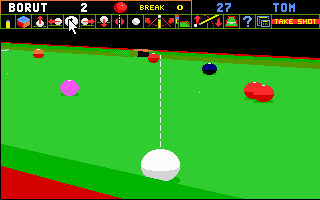
Today you'll appreciate this game if snooker interests you at all — or if you want to see how you could make a solid sports sim thirty years ago without a budget and without a 3D engine. It plays surprisingly well in a browser, the controls are easy to learn and you can finish a match in twenty minutes. No installation, no DOSBox, no hassle. You start it, play, close it. That's exactly how it worked back then too.
 old
old


 ▶Sensible World of Soccer 2016/20172016MS-DOS / PC
 ▶European Club Soccer1993Sega Mega Drive
 ▶Championship Manager 93-941993MS-DOS / PC