لم تُترجم هذه المراجعة بعد — نعرض النص الأصلي (English).
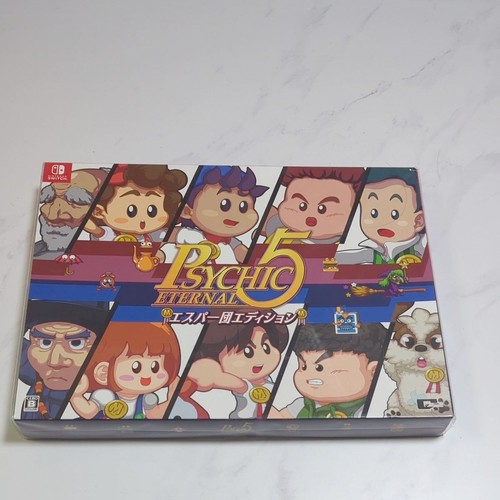
Jaleco put Psychic 5 into arcades in January 1987; the developer was Nihon Maicom Kaihatsu, better known by the initials NMK. The presentation is deliberately disarming - soft pastel colours, child protagonists swinging mallets, enemies drawn as possessed clocks, umbrellas, chairs, teapots and toasters. The game underneath is not gentle at all.
You pick one of five psychics and try to reach Satan, who waits at the far end of each of the eight scenes. Only two are available at the start: Naoki, twelve years old and average at everything, and Akiko, ten, who hovers well but pushes badly. The other three sit locked in a glass jar hidden once per stage; smash it and they join the roster. Bunta hits hardest and shoves heavy doors open fastest, Makoto jumps highest and runs quickest but presents a bigger target, and 88-year-old Genzoh swings a staff instead of a mallet, moves at a crawl, and has both the strongest attack and the longest hover. A phone box in each level lets you swap.
Systems stacked on systems
Control is one stick and two buttons, with jump height set by how long the button is held and descent speed adjustable in mid-air. Around that sits an unusually elaborate item economy. Breaking jars releases food; every sixth piece loads an item into a five-slot rack at the top of the screen. A cursor sweeps that rack continuously, and smashing a question box at the exact moment the cursor sits over a stored item is what hands it to you. Miss the timing and you get whatever the box held by default instead. Witches flying through the level drop a broom when hit, granting free flight, freezing the clock and the monsters, and reducing everything to one-hit kills.
The result is dense, fast and frequently unreadable. A hard timer pushes you forward while the item system rewards memorisation, a combination that grinds newcomers down. Shinichi Sakamoto's soundtrack, deliberately written with the verse-chorus structure of pop music to prove the hardware could do it, has aged considerably better than the difficulty curve. It runs in the browser; expect your first several attempts to last under two minutes.
 old


 ▶Hugo 31995MS-DOS / PC


 ▶Amazing Spider-Man1990MS-DOS / PC
 ▶Commander Keen 4: Secret of the Oracle1991MS-DOS / PC

