لم تُترجم هذه المراجعة بعد — نعرض النص الأصلي (English).
In 1989, having a computer at home meant you were one in forty people in your neighborhood. And a printer? That was pure luxury. I remember a classmate from fifth grade whose dad brought home a needle-impact Epson — and suddenly the whole class knew where birthday invitations got printed.
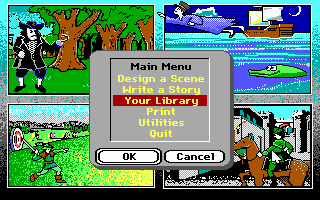
Peter Pan and Robin Hood Fairy Tale Factory isn't a game in the traditional sense. Hi-Tech Expressions was pumping out a whole series of similar "factory" titles aimed at kids back then — and this one was essentially a print tool disguised as entertainment software. The program offered pre-made graphics with characters from Peter Pan and Robin Hood that you could arrange and print into invitations, postcards, banners, and similar creations. Creativity went hand-in-hand with practical results — something you could take off the desk and show to the world.
The controls were designed for absolute beginners, especially children. You pick templates, arrange characters and text, set up your printer, and go. No complex logic, no score, no game over. If this sounds trivial to you, you're right — but back then, the simple act of printing a color picture of Peter Pan was reward enough. The software was exactly as simple as it needed to be for a ten-year-old to use without reading a manual.
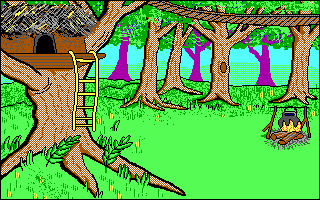
What do we remember about it? Mostly the context. This was a genre that barely exists today because the internet and Canva swallowed it whole. But back then, programs like this from Hi-Tech Expressions filled a real gap — parents bought a CD or floppy disk, kids got to play around and actually make something. From a 2024 perspective, it's a curious artifact from when software had to justify its price with tangible paper output. The graphics match late-eighties EGA standards — twenty-four colors and pixels the size of a small castle.
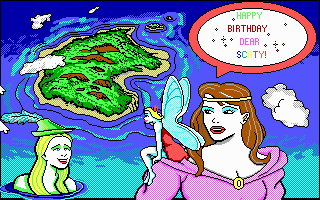
Today you'd play this mostly out of nostalgia or curiosity rather than for any practical use. If you were printing party invitations with software like this back in 1989, it's worth a five-minute peek to see what it actually looked like. Browser-based emulation via DOSBox makes it accessible without much hassle. Expecting anything more than a glimpse into an era when home printing was a small miracle would be asking too much.
 old
old ▶Wizardry 7: Crusaders of the Dark Savant1992MS-DOS / PC
 ▶Morse v1.0T1996MS-DOS / PC
 ▶Richard Scarry's How Things Work in Busytown1994MS-DOS / PCMach▶MachMS-DOS / PC


 ▶Arya Vaiv1994MS-DOS / PC

