One of those games in the catalog you don't care about until your monitor goes dark. Blockade is a quiet logic game from the eighties that someone once threw into a collection next to Tetris and Space Invaders, and everyone walked past it. But this is a shard waiting for you.

It's a puzzle based on occupying space. You have a playfield, two players (you and the computer), and the goal is to create your routes or blocks while occupying territory. The game sometimes reminds you of Nibelungen or older strategies where there's no chance, just decisions. Both players alternate, and each move means something different—you expand territory, block opponents, or trap yourself in your own strategy. Simple rules, deep breakthrough.
Control is simple: cursors or numbers on numpad. Everything happens in a mode where you see immediately what happens—no delays, just pure calculation. Graphics are almost directive in minimalism: squares, lines, coloring. Sound? Occasional beep. Nothing unnecessary. Playing then focuses on one thing—is my next move smart or am I falling into a trap? The computer plays solidly. Sometimes it gets beaten, often it improves you, and some games drag to a point where neither of you knows who's better.
Blockade isn't known because it was released without much publicity and disappeared among a flood of games that swamped the market in the nineties. It's neither sensationally fun nor bad—it's just logic, tense and without beating around the bush. In an era when even puzzle games try to be spectacular, this one looks at you from a black monitor and waits what you've got.
Today it suits those who like quiet strategies without dice and unnecessary graphics. Try it in a browser or emulator when you want to experience how logic looked without fireworks. Sober, cold, and yet you remember it.
 old
old

 ▶Teenage Queen1988MS-DOS / PC


 ▶Mario is Missing!1992MS-DOS / PC

 ▶The Backyard1993MS-DOS / PC


 ▶Tetris1985MS-DOS / PC

 ▶Boulder Dash1984MS-DOS / PC
 ▶Vlak1993MS-DOS / PC
 ▶Supaplex1991MS-DOS / PC
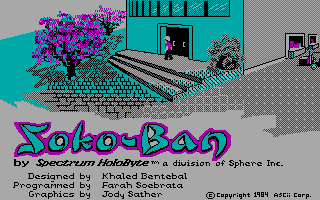 ▶Sokoban1984MS-DOS / PC