In 1989, I sat hunched over a keyboard trying to navigate an interface that looked like an accounting printout from some ancient Chinese province. Bandit Kings of Ancient China by KOEI wasn't a game that welcomed you with open arms — it threw you into the deep end and waited to see if you'd swim.
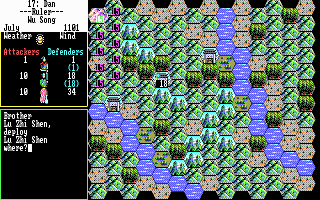
The game draws from the classic Chinese novel Water Margin. You play as one of the historical bandit leaders who, in a turbulent 12th-century China, attempt to unite rebel bands, recruit loyal generals, and ultimately gain enough power to have their story written into legend. The goal isn't purely military — it's political, social, and at times almost diplomatic.
Mechanically, it's turn-based strategy with regional management, where you must balance dozens of parameters simultaneously. Population sustenance, soldier morale, general loyalty, supplies, taxes. The interface is text-based and menus branch to a depth today's players aren't accustomed to. KOEI would reuse this system again and again in later games — Romance of the Three Kingdoms, Nobunaga's Ambition — and Bandit Kings is essentially one of the first fingerprints of this approach on PC. Battles are schematic, almost symbolic, but the planning before them will reliably consume hours of your time.

What aged worst is the entry barrier. Without the manual, you won't get anywhere — and I mean that literally, not as hyperbole. The game provides almost no guidance built-in, and numerical values without context tell you nothing. In 1989, you read the manual because there was no other choice. Today, it's a filter that weeds out everyone except a certain type of patience. Those who push through will discover a surprisingly deep political power simulator where purely military solutions only work in the short term.
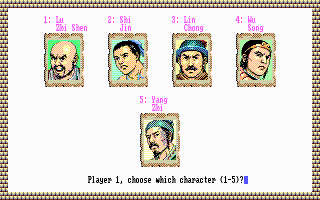
Today, Bandit Kings suits those who love KOEI classics and want to see where the style began. Or history enthusiasts who've read Water Margin and want to experience that era from a different angle. You can run it in a browser via DOSBox emulators like Internet Archive without installation — and then spend the first half hour hunting for the manual. But that's part of the experience with KOEI games from this era.
 old




 ▶Sid Meier's Civilization1991MS-DOS / PC


 ▶Chess1998Sega Mega Drive


