The year is 1991, the Soviet Union is collapsing live on television, and the screens cut between falling statues and scenes of civil war. The developers at Midnight were watching, and a year later they released Ashes of Empire — a game that turned breaking news into a game map.
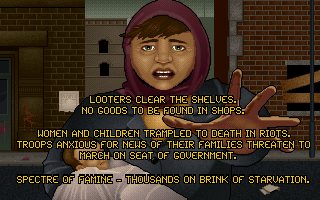
The setting is straightforward to the point of provocation: you play as some kind of armed peacekeeper sent to a fictional but clearly post-Soviet inspired country torn by civil war. The goal is to bring stability — and since diplomacy is boring, that means mostly destroying enemy military installations and eliminating armed factions. The title isn't a metaphor. The empire fell, ashes remain, and you're here.
The game is action-packed with an isometric perspective. You control a vehicle — this mechanic is the backbone of the entire experience — and drive through enemy territory where infrastructure awaits destruction. The controls match the DOS action game standard of the era, which today means: stiff by modern standards, with certain inertia and a learning curve. Those who grew up with similar games know what I'm talking about. Those who didn't might struggle with the keyboard as much as the enemy.
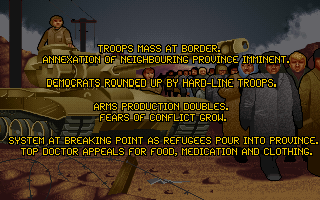
What set Ashes of Empire apart from its contemporaries was the openness of the world — not a sandbox in today's sense, but a space that didn't feel like a linear corridor. The maps are expansive, missions offer some freedom in approach. Visually, the game fits early nineties standards: functional, without inflated ambitions, with that characteristic VGA palette your brain automatically associates with computer fans and floppy drive clicks. Music and sound are exactly as average as you'd expect from 1992. It hasn't aged poorly — it simply looks and sounds like nothing but what it is.
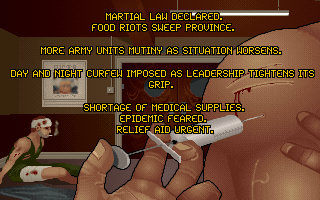
Today, Ashes of Empire lands perfectly for retro action game fans who enjoy something less canonical than Dune 2 or Syndicate. It's not a hidden gem that deserved more attention — it's solid, period-authentic action with an interesting thematic backdrop that few dared touch in the nineties. Fire it up in your browser via DOSBox without issues, and the first twenty minutes will remind you how differently games paced back then. No tutorials, no waypoints. Just a map, an objective, and you.
 old
old


 ▶Doom1993MS-DOS / PC


 ▶Contra1988MS-DOS / PC


 ▶Ultimate Mortal Kombat 31996Super Nintendo


