Bài đánh giá này chưa được dịch — chúng tôi hiển thị bản gốc (English).
Year 1988, your parents brought home a floppy disk with the Sesame Street logo and you looked excited, even though you had a feeling this wouldn't be Another World. Sesame Street: Letter-Go-Round by Micromosaics is an educational game for the youngest players that, on MS-DOS, masqueraded as a fun trip to a carnival — and to a certain extent, it delivered on that promise.
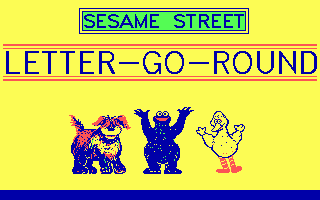
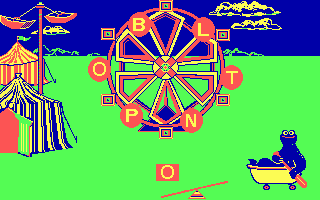
The game places players in the world of Sesame Street and its muppet inhabitants, who invite you to a carnival. The centerpiece is the titular Letter-Go-Round, a kind of carnival wheel whose purpose isn't to spin, but to practice letters and spelling. Genre-wise, it's a pure educational title for preschool and early school age — letter recognition, matching, simple word puzzles. The goal is clear: children are supposed to learn the alphabet and the basics of English in an unforced way.
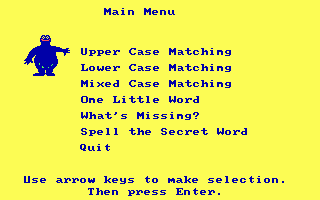
The controls are simple enough that even a child who hasn't quite gotten the hang of holding a mouse can manage. The game offers several game modes with varying difficulty levels, selected through the main menu — which was standard for educational titles at the turn of the eighties and nineties. The graphics are acceptable for DOS in 1988, the characters are recognizable and colorful, though the grainy monitors of that era didn't help much. The sound depended on whether you had a PC speaker or the rarer soundcard of the time — the difference was dramatic, but neither would ruin the basic experience.
We remember it mainly because the Sesame Street license meant a guarantee of a solid educational package on computers back then. Micromosaics knew who they were making it for, and they didn't try to show off any technical tricks. Today, the game has aged exactly as expected — like an artifact from a classroom in the late eighties. Its English focus never made it a hit with Czech-speaking children, so it flew more under the radar here than in the States.
Today it makes sense mainly for collectors of licensed DOS titles and for parents who want to show their kids what "educational gaming" looked like before the tablet era. You can get it running in a browser emulator without any trouble, and within fifteen minutes you've got the full picture of what it offers. The nostalgia here is more cultural than gaming — but sometimes that's enough.
 old
 Sesame Street Letter-Go-Round IBM Tandy Computer Game Software CIBQuảng cáoXem trên eBay »


 ▶Vlak1993MS-DOS / PC

 ▶Supaplex1991MS-DOS / PC

 ▶Sokoban1984MS-DOS / PC


 ▶Chess1998Sega Mega Drive
 ▶Boulder Dash III1986ZX Spectrum


