I remember sitting in front of the monitor in fifth grade, shuffling through a box of floppy disks, and stumbling upon this thing. No action, no shooting — just squares and a picture slowly revealed like a wet wall.
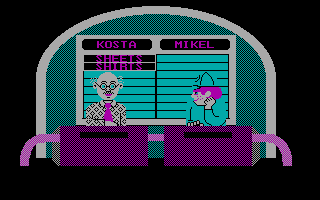
Classic Concentration from 1988 is a computer adaptation of the American TV game show of the same name. It's a memory matching game with an added layer: hidden beneath the tiles are pairs of symbols, but the real goal isn't just to match them all — as you uncover tiles, a visual puzzle gradually reveals itself, a rebus you need to solve before your opponent does. Softie, Inc. stayed faithful to the TV format, so if that show entertained you as a kid, you know exactly what you're getting into.
The controls are straightforward to the point of bluntness — arrow keys, selection, confirmation. You can play solo against the computer or two-player on one keyboard. The visual puzzles are English-language rebuses, so anyone whose English wasn't great back then sat staring at the picture like it was Egyptian hieroglyphics. That's not a knock against the game, just an honest admission of my own language skills at the time. The graphics match 1988 DOS standards — functional, nothing dazzling, but clear. The sound design is more decoration than experience.

What really gave the game its backbone was that dual mechanic: memory matching alone isn't enough; you have to simultaneously read and interpret the image that's slowly taking shape. It's an idea that worked on television and worked on a monitor too. The game has aged gracefully — there's nothing in it that falls apart. English rebuses might be a barrier for some players, but anyone comfortable with English gets a pure, compact logic puzzle with no frills attached.
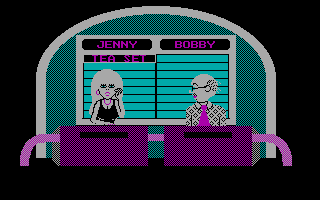
Today, you'll play it if you want five minutes of pure calm with a game that doesn't try to be more than it is. No story, no progression, no content unlocks. Just squares, symbols, and a rebus. Fire it up in your browser via DOSBox without a hitch, and the whole experience lasts exactly as long as it needs to — which is actually the highest praise for a logic game from 1988.
 old
old


 ▶Tetris1985MS-DOS / PC
 ▶Boulder Dash1984MS-DOS / PC

 ▶Sokoban1984MS-DOS / PC
 ▶Vlak1993MS-DOS / PC


 ▶Supaplex1991MS-DOS / PC
 ▶Chess1998Sega Mega Drive


