این نقد هنوز ترجمه نشده است — متن اصلی (English) را نشان میدهیم.
You're piloting a train through what looks like a fever dream drawn on graph paper. Loco, Antony Crowther's 1984 effort for the Commodore 64, strips locomotion down to its skeleton—you steer left and right, collect cargo, and try not to derail into the scenery. It's as simple as a game gets, and that simplicity is both its charm and its curse.
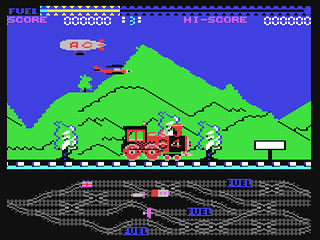
The concept is straightforward: your blocky train winds through increasingly twisted tracks, and you need to grab glowing pickups while avoiding obstacles. There's no story to speak of, no explanation why you're doing this. Alligata Software just wound you up and let you go. The Commodore 64's chunky pixel palette does the heavy lifting—everything looks like it was assembled from construction toys, which somehow works in the game's favor. It feels intentional rather than primitive.
Mechanically, Loco is all about timing and rhythm. The train moves in a fixed pattern, and your only real control is steering it slightly off course to snag items or dodge hazards. It sounds tense on paper, but the execution feels sluggish. There's a delay between your input and the train's response, which can feel natural for something as heavy as, well, a train, but it makes the game frustrating rather than challenging. You're reactive, not in control. After a few rounds, you've learned the patterns, and it stops being a puzzle and starts being a chore.
What lingers is the aesthetic. This is mid-80s British budget gaming at its most unpolished—rough around the edges, no hand-holding, no tutorial, just "here's a train, now what?" It has personality precisely because nobody worried about mass appeal. Crowther's work for the 8-bit scene was prolific but often forgettable; Loco sits somewhere in the middle—competent but forgettable.
Today, Loco works as a time capsule. It's the kind of game you boot up in a browser, play for five minutes, and understand exactly what a Tuesday afternoon in 1984 felt like for kids with £3 to spend. Not every game needs to be rediscovered as a hidden gem. Sometimes they're just what they are: a modest, dated curiosity that taught us nothing except that not everything from the past was gold.
 old