این نقد هنوز ترجمه نشده است — متن اصلی (English) را نشان میدهیم.
You stand before a black tower and you know there will be trouble. Dark Castle from the mid-eighties is a series of surprises wrapped in graphics that look like someone drew them on paper and then scanned them in. It's not elegant, but it has its own feel — dark, a little ugly, but memorable.
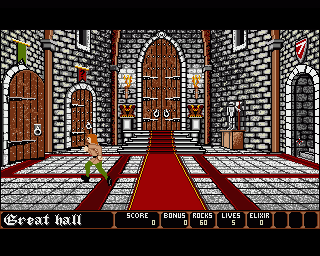
It's a logic platformer released by Apple Computer for Macintosh and later made its way to DOS. It plays you like an explorer in a gothic castle full of traps, enemies, and things that need complicated solving. It's not just about jumping over a chasm — you need to bring a torch here, carry something else out, and watch out for the order in which you do things.
The controls are sticky in the worst sense of the word. The character moves like it has lead feet, jumps have weight and inertia that frustrate you half the time. Walls are hostile, things fall that would rather fall through the screen, but instead they get stuck. It's not a broken game — it's just a game that wants to frustrate you so you'll be careful. Sometimes it works, sometimes it just sends you up the wall.
What makes it interesting now? Mainly the work with layers — it's not just faces and jumping. Every room is a little puzzle. You get stuck without the right object, and then you realize it should have been in the previous room, which you rushed through. In the nineties this would have driven you crazy, today it's more of an archaeological feat, you're curious how long you can stick with it.
It's aged worse than its idea. The graphics are shiny and sticky, the sounds from the speaker are catchy, and especially on the DOS version it sometimes stutters. Not even physics — more like technical debt.

Playing it today is worth it, but not for fun. Rather so you can see what a puzzle platformer looked like at a time when nobody was quite sure what it even was. Emulators and archives will get it into your browser in minutes. Weak, hard, cryptic — but a living fossil.
 old
old


 ▶Super Solvers Gizmos and Gadgets1993MS-DOS / PC


 ▶Tetris1985MS-DOS / PC
 ▶Boulder Dash1984MS-DOS / PC

 ▶Teenage Queen1988MS-DOS / PC
 ▶Sokoban1984MS-DOS / PC