این نقد هنوز ترجمه نشده است — متن اصلی (English) را نشان میدهیم.
You've got a puzzle in your hands that seems to be missing an idea. Cascade Quest is a demo from 2010, back when indie developers hadn't yet figured out they could take a gameboy and build a studio on it — here you're left with an empty room and the will to put something together.
It's a logic game with cascades of colored elements. The goal is to manipulate falling or arranged elements on screen so they connect into groups and vanish. Old story: sets of three or more matching things disappear, the rest shift, space opens up for new ones. The game plays out in a 2D window in the middle of a black field, so everything looks provisional — there's no menu with icons, no polished graphics. Just playing and playing.
The controls are simple, dragging with the mouse couldn't have been done more elegantly. But the pace isn't pleasant — elements move slowly, the game's response isn't instant. You feel like you've got a computer behind you, not that the game would intuitively predict your next move. Once you pull off your first ten combinations, you know everything there is to know. There's no twist, no surprise. Just repetition over and over.
Cascade Quest belongs to the world of projects that came together over a weekend and stayed what they were — a sketch. In the nineties, this game would have ended up on a CD among other shareware titles and nobody would have thought twice about it. Today you see in it the sand from which bridges were built. Puzzle games need content, pace, and some personality. Here there's only skeleton without meat.
You can try it if you enjoy pure logical game mechanics without any extra fun. For everyone else: better options exist, even among older titles. Cascade Quest is a good lesson that not every idea deserves to become a game.
 old
old


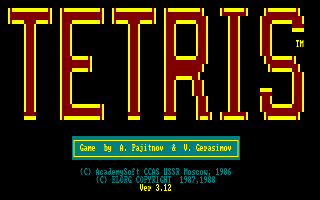 ▶Tetris1985MS-DOS / PC
 ▶Boulder Dash1984MS-DOS / PC


 ▶Teenage Queen1988MS-DOS / PC
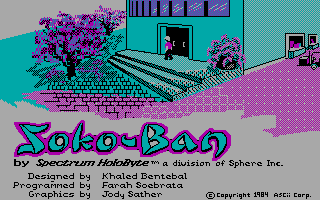 ▶Sokoban1984MS-DOS / PC
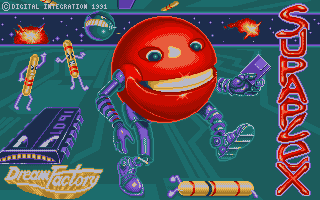 ▶Supaplex1991MS-DOS / PC
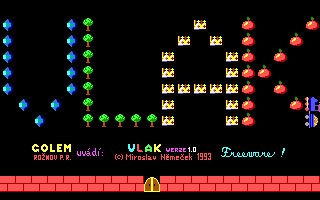 ▶Vlak1993MS-DOS / PC
 ▶Chess1998Sega Mega Drive


