Zip-Zap was published in 1983 by the legendary Liverpool outfit Imagine Software and programmed by Ian Weatherburn. It is an arcade game built on a single genuinely good mechanic: your character cannot stop.
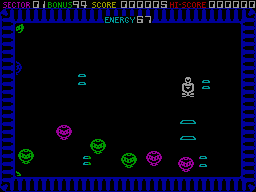
You play a guard robot on the planet Hallucinor whose control circuitry failed during an enemy attack. The motors run permanently and the only thing you can do about it is brake, so all movement is a negotiation with momentum. On each screen you must drive through fuel cells; every one you pass through moves to its position around the Tele-Port. Once they are all in place and the portal is fully energised, you pass through it to the next sector. That sounds simple, but with a robot that never stops, route planning becomes a puzzle — you have to predict where momentum will carry you and brake well in advance.
Presentation is solid for 1983, if not dazzling. Imagine spent most of its money on boxes and advertising, and Zip-Zap is one of those titles where the cover was more ambitious than the cassette. The user score in the ZXDB database has settled at around 5.5 out of ten.
Things to watch for: the game supports cursor keys, Kempston and Interface 2, but the handling is very sensitive and it takes a while to internalise that the brake matters more than the direction keys. Difficulty climbs fast and the sectors begin repeating before long.

Zip-Zap has aged better than expected because its core is a pure physics toy that does not depend on graphics. It is not a big game, but it is a game with an idea — and in a year when Spectrum owners were buried in clones, that was not a given. Worth twenty minutes.
 old


 ▶Pacman's Revenge1987ZX Spectrum
 ▶Bongo1984ZX Spectrum
 ▶Down to Earth1987ZX Spectrum
 ▶Krazy Kong1984ZX Spectrum
 ▶Buggy Boy - East TrackZX Spectrum
 ▶The Chinese Juggler1984ZX Spectrum
 ▶Manic Mower1992ZX Spectrum

 ▶Sideral War1990ZX Spectrum
 ▶Capman1983ZX Spectrum


 ▶The Simpsons Arcade Game1991MS-DOS / PC


 ▶Dangerous Dave1990MS-DOS / PC


 ▶新Mravenečci2026Webová hra

 ▶Pinball Fantasies1992MS-DOS / PC