Recenzia zatiaľ nie je preložená — zobrazujeme pôvodné znenie (English).
First, the field warns you: trains don't belong in this game. Transarctica is an icebreaker simulator — a massive sun-powered train where snow doesn't melt. Early nineties, all electricity's gone, the planet's frozen over, and you've got to make it from northern Russia to the South Pole. Not alone — you're bringing hordes of survivors who'll be hungry, sick, and ready to tear each other apart.
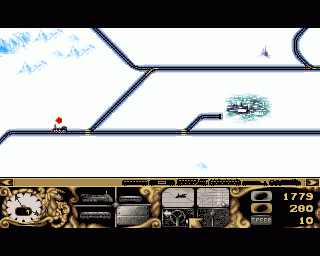
The game throws two things at you — physics and logistics. Running the icebreaker costs energy. Water, food, fuel, spare parts. Everything counts, everything weighs something, everything slows you down. Meanwhile time keeps ticking and the weather does what it wants. When you hit a settlement, you can buy supplies, but your money won't stretch far enough. You've got to choose — how many people do I take, how much space do they get, how many calories fit. Every decision comes down to: what kills me faster, starvation or freezing or blown wheels?
The controls aren't obvious, but once you get the hang of them, the logic clicks. This game won't hold your hand with a manual explaining how to play. You figure it out yourself. You always crash at first. Everyone freezes, everyone dies loud, the game shows you every detail. Then you bring more blankets, fewer people, and try again. Gradually you start understanding what works. It's not about dreading the checkpoint — it's about keeping the map in your head and knowing what's coming.
Transarctica was an interesting experiment on PC. Abroad, a few enthusiasts played it — people who liked suffering and thinking hard. In Czechia, almost nobody knew about it. The graphics are primitive, the music plays the same melody over and over, the colors aren't pretty. And yet — that's part of its charm. There's nothing here to distract you from the fact that you're hammering out there on the ice and panic's creeping in behind you.
These days you play it in DOSBox or some emulator. It's not a relaxing experience or a spectacle. It's about being in trouble, driving without a map, and calculating in your head if you'll make it to the next station. Paradoxically there's something peaceful about it too — you're not in time, you're not in a story. You're just you, the train, and the frozen waste.
 old


 ▶Big Business1990MS-DOS / PC


 ▶Great Naval Battles: North Atlantic 1939-19431992MS-DOS / PC


 ▶Windows 95 in the BrowserMS-DOS / PC


 ▶Pinball Fantasies1992MS-DOS / PC
 ▶NHL '941993MS-DOS / PC