Tätä arvostelua ei ole vielä käännetty — näytämme alkuperäisen (English).
Year 1986. A 5.25-inch floppy brought a game that let me experience what it felt like to command the Enterprise — and reminded me that I read text on a monitor slower than I'd like to admit.
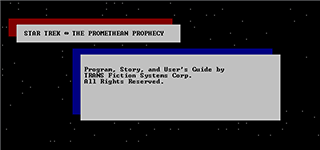
Star Trek: The Promethean Prophecy is a text adventure from TRANS Fiction Systems, published under the Simon & Schuster label. This isn't about action or strategy — you're the captain of the Enterprise, you get an order, a planet or mission, and you solve the rest by typing commands into a text parser. The game draws directly from the original TV series universe that ran from 1966 to 1969. Characters, ships, atmosphere — everything is supposed to be faithful to the source material. And for the most part, it really is.
Gameplay relies on the classic text parser. You type commands, the game responds, you move forward. The parser handles two- to three-word sentences well, but struggles with more complex phrasing — that was the rule rather than the exception in 1986. What's interesting is that the game sometimes lets you control multiple characters at once: you have crew members with specific abilities at your disposal, and choosing the right team members affects how you progress through the game. For a text adventure, it's not a bad system. Less compelling is that some puzzles rely on logic that makes sense only to the designer.
Why do I remember it? Because back then, a licensed Star Trek game wasn't a given. Simon & Schuster released it as a product for fans — and you could tell they approached it with real care. The atmosphere of the original series is there, the dialogue sounds right, Spock speaks like Spock. You couldn't take that for granted in licensed games of the eighties. It's aged exactly as you'd expect: the text parser is a barrier for today's player, the pace is slow, and without the manual you'll fumble around more than you should.
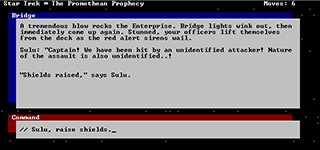
These days, mainly die-hard fans of the original series or text adventure collectors who've conquered Zork and want more will play it in a browser. Don't expect a modern experience — expect a piece of 1986, with the smell of a plastic keyboard and a monitor that hummed a little.
 old
old


 ▶Amazing Spider-Man1989MS-DOS / PC


