این نقد هنوز ترجمه نشده است — متن اصلی (English) را نشان میدهیم.
Sometimes three colors and a handful of blocks are enough. Block-O-Mania remembers this and doesn't overcomplicate things. It's a simple puzzle from the late eighties where pieces fall and you have to stack them so rows or columns disappear. No instructions, no story — just a game field and the wait to see what you'll do.
The game follows an honest rule: you get differently complex shapes in various colors, they stack on top of each other in a grid, and when you fill a row, it vanishes. It's easy to pick up, hard to put down. The controls are intuitive — arrow keys to move, rotation to spin. The pace quickens, tension rises, until one day you realize you've been staring at the monitor for three hours.
What's captivating about Block-O-Mania is exactly that raw simplicity. There's nothing here to distract you, no hip-hop beat or molecular migration. Just waiting for the next block, calculating where to place it, and then that moment when the row ignites and vanishes. The graphics are straightforward, the sounds remind you that the computer is a minimalist. The colors are transparent — blue, yellow, red. No more, no less.
Today's player will recognize it immediately: Tetris, Puyo Puyo, all those clones. Block-O-Mania isn't in a hurry, doesn't claim to be original, and is actually honest about it. It's aged the way forty years age — without worrying that something's missing. You know what you're getting, and you know it right away. No reverse gear, no manual, no tricks.
If you want to play it today, expect primitive in the best sense. It's not a game that will dazzle you with animation or story, but a game that will take twenty minutes from you and take them brilliantly. It runs in a browser without encryption and without excuses. Do you dive into it, give yourself two minutes, or just click it for peace of mind? Both outcomes are correct.
 old





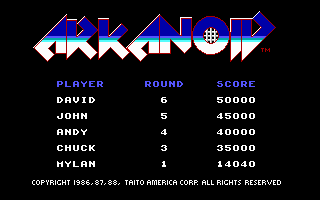 ▶Arkanoid1988MS-DOS / PC

 ▶Boulder Dash III1986ZX Spectrum


 ▶Chess1998Sega Mega Drive


