Year 1993, Impressions Games, and on the screen a world map divided into colored blocks. I remember the first time I launched Global Domination and immediately understood what it was about — this is Risk, but on a computer.
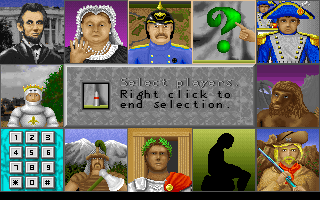
It's a turn-based strategy for one to five players, where each controls a part of the world and the goal is to devour the rest. No story, no missions, no plot twists — pure geopolitical dominance on a global scale. Before you start, you set the difficulty and game complexity, then you find yourself at the world map and begin planning your expansion route.
The mechanics are straightforward to the bone. You move armies, attack neighbors, defend your own territory. Battles are decided by dice — or their digital equivalent. Anyone who knows the board game Risk will feel right at home immediately, maybe even too much so. The computer opponent plays decently, but not particularly deviously, so an experienced player will read it fairly quickly. Greater challenge comes only in multiplayer mode, where a human opponent sits next to you at the same machine and negotiates truces with icy calm.
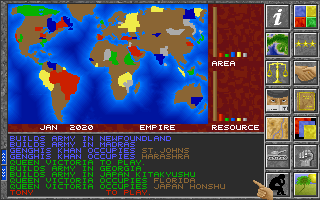
What Global Domination brought in 1993 was mainly accessibility. Risk as a board game required physical players, an evening, a spread-out table, and the patience of the whole family. This you could launch alone, anytime, without arrangements. Graphics were never an ambition — it was about a functional interface, not a spectacle. And as a functional interface, it held up. What aged worst is exactly that ceiling of simplicity: after a few games, the mechanics reveal their limits and no deeper strategic layer is found. There's no diplomacy system, the economy remains marginal, and the randomness in battles can really irritate you when you thought you had it won.
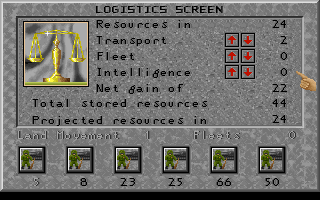
Today, Global Domination will be played by those who want light strategy for half an hour without having to read an eight-page manual. It's a pleasant time capsule from an era when a simple idea and solid execution were enough. If you played Risk as a kid with the board game version and are curious how it looked on a CGA/EGA era monitor — here's your answer.
 old
old


 ▶North & South1990MS-DOS / PC


 ▶Teenage Queen1988MS-DOS / PC


 ▶Chess1998Sega Mega Drive


