Hindi pa naisasalin ang review na ito — ipinapakita ang orihinal (English).
Sound Blaster was crackling, the 486 fan was humming, and something was spinning on the screen that I couldn't quite make sense of back then. Psygnosis released Pyrotechnic in 1995, and I remember looking at a friend's monitor thinking: so this is what it looks like when someone takes a space shooter and literally turns it on every side.
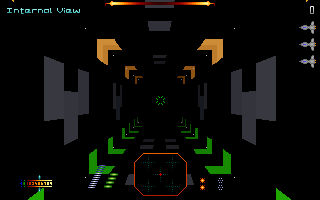
Pyrotechnica is an action shooter from a first-person perspective set in a space environment. The foundation is simple: you fly, you shoot, you survive. The narrative setting plays with the theme of long-dead stellar civilizations and secrets hidden in the depths of space — the actual plot is more of an excuse than a core structure, as was typical for action games of that era.
What set Pyrotechnica apart from the then-dominant Doom clones was the movement. Full three-dimensional freedom of movement on all axes — no walls, no gravity, no restrictions. Enemies come at you from all directions at once, and spatial orientation is a constant problem, not an occasional one. That was quite a bold design move for 1995. At the same time, it's where the game most noticeably creaks today: without a proper navigation system, spatial disorientation quickly shifts from thrilling challenge to exhausting chaos. The controls demand time and learning, and most players back then didn't go for the mouse — a joystick was the reality.
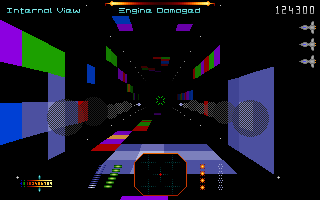
Psygnosis had a good eye for visual presentation back then. Descent by Parallax Software came out just months earlier and showed where the bar was set. Pyrotechnica doesn't win the comparison with Descent, but it's no shame either — the graphics match the year of release, the lighting effects of explosions are decent for the time, and the soundtrack keeps pace with the action. For how brutally the game presents itself, the audio is surprisingly bearable.
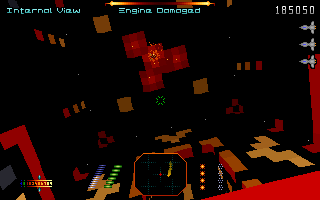
Today Pyrotechnica appeals mainly to those who remember what the genre looked like before Half-Life — people who want to see how developers in the mid-nineties tried to push the boundaries of three dimensions. It's not a classic you wait for with nostalgia. It's more an interesting document of its time, a dead-end branch in genre evolution that could have led somewhere interesting — and ultimately didn't. Playing it today in a browser is fun for a while, then your neck starts hurting from all that constant rotation. But those few minutes are worth it.
 old
old


 ▶Doom1993MS-DOS / PCGrand Theft Auto (DMA Design)▶Grand Theft Auto (DMA Design)1997MS-DOS / PC


 ▶Contra1988MS-DOS / PC

 ▶Ultimate Mortal Kombat 31996Super Nintendo
