It's 1993, I'm handing the controls to a friend and he's sitting at the monitor staring at the pitch from above, where little nail-sized figurines are running around. "Those are footballers?" I ask. "That's the best football game in the world," he answers without turning around.
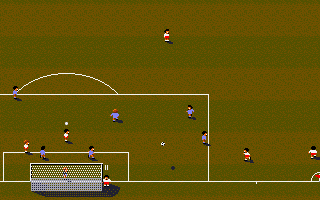
Sensible Soccer — specifically the European Champions 92/93 edition by Sensible Software — is arcade football viewed from above. No 3D graphics, no slow-motion replay animations. Tiny sprites, green pitch, fast-paced action. Licensed European clubs and players from that season, which was quite a strong draw for PC gaming back in 1993.
The controls are intentionally simple — movement, pass, shoot, plus the ability to put spin on the ball after a shot. That spin is the heart of the whole game. Without it, Sensi is just a quick ping-pong match with a football. With it, you suddenly start doing things that look like accidents, but after ten hours of play they start looking intentional. The game's pace is wild, goals fly in quickly and matches last minutes. A realistic football simulator it is not, and it never wanted to be.
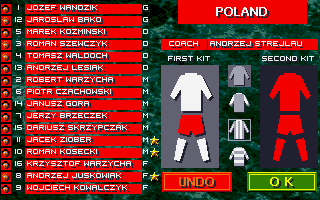
What Sensible Soccer did better than most of its competition back then was smoothness and instant fun for two players. Sitting at opposite ends of a single keyboard or with a joystick in hand, it became a genuine relationship stress test. Friends I knew played it for hours — and that's quite a statement for an arcade football game. Personally, I never counted myself among its biggest fans; I found it a bit shallow for longer solo sessions, but it's hard to fault a game that was built primarily to make you shout across the table.
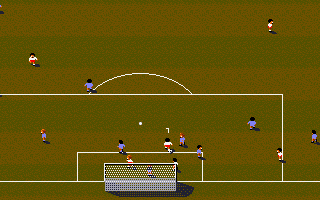
Today the game has aged exactly as you'd expect from this genre — the graphics won't offend but won't impress either, and without a live opponent it gets old pretty quick. If you want to play it today in your browser, you get an authentic slice of a time when football games bet on speed and reflexes instead of licensed commentators and hair physics. For those who remember it, it's a reliable blast from the past. For the curious, it's a solid twenty minutes — until you understand why people used to call gaming magazines and vote for it as Game of the Year back then.
 old
 PAC-MAN Classic Arcade T-Shirt Tee Retro TeeseBay पर देखें »
 Pac-Man Rex Dinosaur Figure 2.64in Tall 3D CollectibleeBay पर देखें »


 ▶The Manager1991MS-DOS / PC

 ▶NHL '941993MS-DOS / PC


 ▶European Club Soccer1993Sega Mega Drive


 ▶PC Basket 3.01995MS-DOS / PC