Year 1982, and someone at The Learning Company decided that the best way to explain logic circuits to kids was to give them a boot and a conveyor belt with moving shapes. Sounds like a joke. It's not.
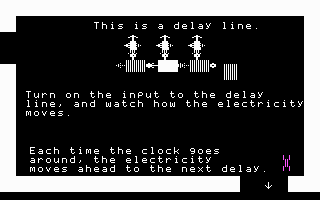
Rocky's Boots is an educational logic game that teaches the fundamentals of Boolean logic — AND, OR, NOT operators and their combinations — through visual circuit building. The player gradually assembles wiring from symbolic components, with the goal being the correct reaction: the boot kicks the shape that matches the given condition and ignores all the others. No story, no villain. Just circuits, a boot, and conveyor belts.
The controls are surprisingly intuitive for their time. You drag components, wire them up, test them. At first, simple circuits suffice — one sensor, one gate, the boot kicks. Gradually more input conditions appear, negations, nested combinations, and suddenly you're sitting over the screen, sketching truth tables on paper, wondering if this really is supposed to be a kids' game. It is. And it works. Abstract logic becomes a tangible thing through visual metaphor — and that was genuine pedagogical breakthrough in 1982.
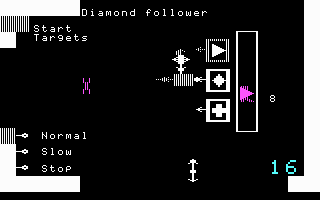
What it brought to the table is hard to overstate today. Rocky's Boots was one of the first games that didn't try to test logic with quizzes, but let players build it directly. This was years ahead of its time. It's aged graphically, sure — monochromatic or CGA palette, screen movement that feels like wading through mud in 2024. But the core, that principle of wiring circuits and immediate visual feedback, holds up. Modern games like Opus Magnum or various puzzle-programming titles do essentially the same thing, just with better rendering.
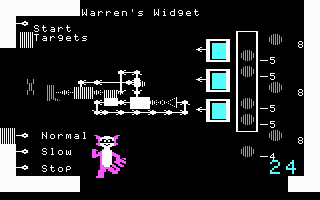
Today it appeals mainly to two types of people: those who played it as kids and want to verify whether that feeling of "this was clever" was justified (it was), and anyone teaching or learning the basics of logic circuits who wants something other than a textbook. It runs flawlessly in a browser via emulator, an afternoon of fun is guaranteed — assuming the phrase "AND gate" doesn't fill you with panic.
 old
 Tetris Multicolored Pieces T-shirt Black from Video Fame在 eBay 查看 »
 POP MART 100 Mega Space Molly Series 3 Confirmed Figure Toy在 eBay 查看 »






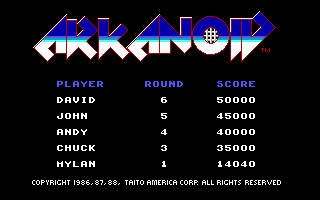 ▶Arkanoid1988MS-DOS / PC

 ▶Chess1998Sega Mega Drive
 ▶Boulder Dash III1986ZX Spectrum


