 old


 ▶Jimmy Connors Pro Tennis Tour1990MS-DOS / PC


 ▶World Tour Tennis1993MS-DOS / PC


 ▶Pete Sampras Tennis1994Sega Mega Drive
 ▶Sampras Tennis 961995Sega Mega Drive
 ▶Jennifer Capriati Tennis1992Sega Mega Drive
 ▶ATP Tour Championship Tennis1994Sega Mega Drive
 ▶IMG International Tour Tennis1994Sega Mega Drive
 ▶Final Match Tennis1991PC Engine / TurboGrafx-16


 ▶Tennis Manager 981997MS-DOS / PC
 ▶Pro Tennis Tour - Great CourtsZX Spectrum
 ▶Wimbledon '971997ZX Spectrum
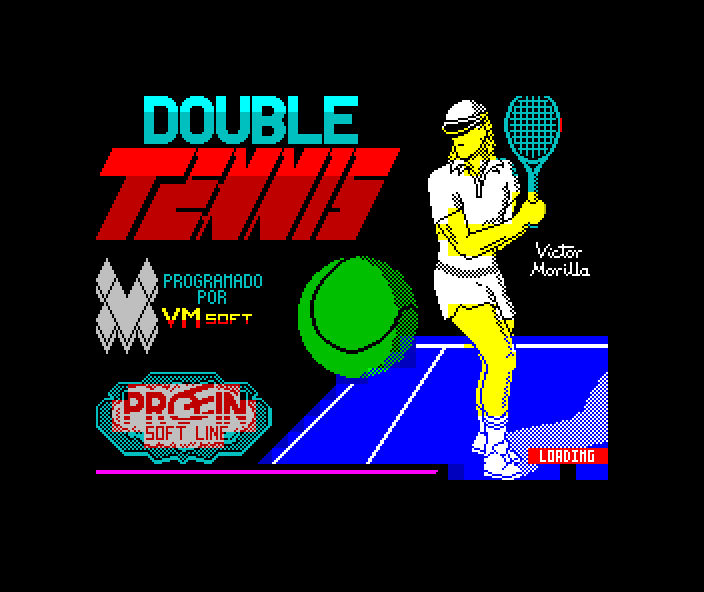 ▶Double Tennis1990ZX SpectrumPassing Shotmaklumat sahajaPassing ShotMSXCenter Courtmaklumat sahajaCenter CourtMSXTie Break Tennis 2maklumat sahajaTie Break Tennis 21999MS-DOS / PC
Tennis was one of the first sports to reach a screen, and for years the games could only manage the geometry: a court, two figures and a ball that bounces. What actually changed through the 80s and 90s was the input. Early titles such as Psion's Match Point, On-Court Tennis and RealSports Tennis gave you movement and a single button, and the shot was decided almost entirely by where you were standing when the ball arrived. By the end of the era that button had become a choice — flat, topspin, slice or lob depending on which key you pressed and how long you held it, with the moment of the swing setting the depth and your approach setting the angle.
European studios drove most of that change. Blue Byte's Great Courts, sold in North America as Pro Tennis Tour, built a circuit of tournaments on top of a swing system that rewarded early preparation, and Great Courts 2 extended it. Ubi Soft's Jimmy Connors Pro Tennis Tour worked along similar lines with a ranking to climb. Loriciel produced Tennis Cup and Tennis Cup 2, and Infogrames covered the same ground with Advantage Tennis and International Tennis Open, while Tennis Manager 98 dropped the rallies entirely and left you running a player's season.
The technical outlier is 4D Sports Tennis, developed by Distinctive Software and published by Mindscape in 1990 as part of the 4D Sports line. It replaced sprites with polygon players and let you move the camera — from behind the baseline, from above the court, from the side — and replay the point afterwards. The frame rate was the price, but it was the first tennis game where the shape of a rally could be seen in three dimensions rather than inferred from a flat view.
Consoles kept their own version of the sport. Codemasters released Pete Sampras Tennis for the Mega Drive on a cartridge with two extra controller ports built into it, so four people could play doubles without an adapter, and followed it with Sampras Tennis 96. The same machine had ATP Tour Championship Tennis, Jennifer Capriati Tennis and IMG International Tour Tennis, while on the PC Engine, Final Match Tennis is still held up as one of the best playing tennis games of the 16-bit years. Later, Tennis Elbow arrived from a single independent developer and carried the simulation line on long after the large publishers had moved away from it.
Titles marked as playable run directly in the browser through an emulator, with no installation and no registration. A keyboard is enough for all of them, and the two-player modes work with two people sharing one.