Ez az ismertető még nincs lefordítva — az eredetit mutatjuk (English).
It was 1997 and I sat in front of a monitor with green phosphor in my eyes, reading a story about a bar where aliens, vampires, and time travelers gathered. And it was normal. Completely normal.
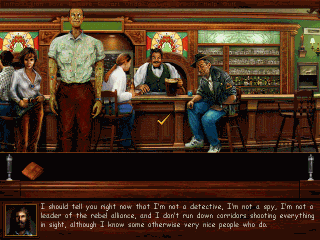
Callahan's Crosstime Saloon is based on Spider Robinson's book series — an American science-fiction humorist whose Callahan's bar is a place where everyone has a drink, tells their story, and somehow things get resolved. Legend Entertainment, the studio behind some solid adventures of the nineties, turned it into a text-and-graphics adventure where you play as Jake Stonebender, a regular at the aforementioned establishment. You come in, meet strange patrons, listen to their troubles, and get involved in solving problems that most bars would rather ignore.
The game works with an interface combining mouse clicks with text command input — Legend hadn't completely abandoned the text element back then, and here it makes sense, because wordplay is part of the game mechanics itself. Robinson is known for his characters solving situations with pun-invoking wisecracks, and the game relies on this literally. Some puzzles require you to understand an English pun and then type it in correctly. That was a tricky ask even back then, and today, if you're playing in Czech, it can be pretty frustrating at times.

What holds your attention is the atmosphere. Callahan's bar has its own logic of hospitality and good-heartedness that doesn't come across as sentimental, but genuine — and that's unusual for a 1997 adventure. The characters have personality, the dialogue isn't rushed, and the humor works on more layers than just visual gags. The graphics are dated, nothing dazzling then or now, but the sound design — where the studio invested in voice acting — keeps the game alive better than pixels. What aged poorly: the logic of some puzzles is arbitrary to the point of pain, and navigation at times assumes you've read the source material.

Callahan's Crosstime Saloon will suit a player who loves adventures built on story and dialogue more than pixel-hunting. And who either reads English comfortably, or has patience with puns in a foreign language. It's a game that doesn't need to be the prettiest or the longest — it's enough that it has its own world and holds onto it from start to finish. Not many games like that came out back then.
 old


 ▶Amazing Spider-Man1989MS-DOS / PC


 ▶Fantasy - An Adult Game1987ZX Spectrum


 ▶Leisure Suit Larry 6 - Shape Up or Slip Out1993MS-DOS / PC