Year 1994, New Jersey. The world is gripped by nuclear catastrophe, civilization has crumbled, and from the ruins of Hoboken emerges a band of superheroes whose abilities are — to put it mildly — underwhelming. I played as the team leader named Crimson Tape, whose only superpower consisted of drawing up organizational charts. This wasn't a parody. Well, it was, but the game meant it deadly seriously.
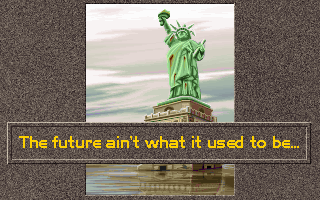
Superhero League of Hoboken from Legend Entertainment is a turn-based RPG with adventure elements, set in post-apocalyptic New Jersey. The goal is straightforward: reunite the remnants of civilization under your superhero team's banner. Except the team consists of characters with abilities like "pasta cooking" or "spotting bad haircuts." Legend specialized in text adventures and humorous RPGs — just mention the Spellcasting series — and they brought that approach here in full force.
Gameplay combines turn-based combat on a grid-based map with dialogue scenes and item hunting. The battles aren't particularly deep, but the parodic context makes every encounter an event. Individual missions have specific objectives and the game guides you with a pretty firm hand — no wandering aimlessly for hours on end. Humor isn't just in the descriptions, it's baked right into the mechanics. A character who can cook pasta will actually use that skill meaningfully at a certain point. Meaningfully, at least within this world's logic.
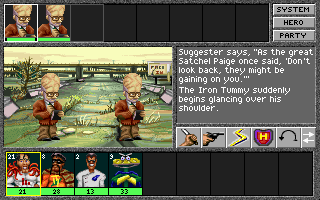
What hasn't aged well? The interface is noticeably from an era when "user-friendliness" was still learning to write. Graphics were never the game's strong suit, even by 1994 standards. The game looked modest even back then. On the other hand, the text humor holds up surprisingly well — absurd descriptions, character one-liners, gentle satire on the American comic book superhero canon. This kind of irony, unlike pixels, doesn't fade.
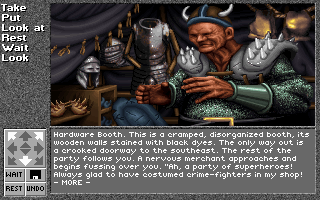
Today the game suits anyone looking for a lighter RPG with an emphasis on humor and story, not build optimization. If you vibed with the first Quest for Glory or Fallout 1 back in the nineties for their tone rather than complexity, you'll find a kindred spirit here — just considerably less ambitious and much more willing to not take itself seriously. Fire it up in your browser via DOSBox Online without any trouble, and the first half hour will tell you everything you need to know.
 old

 The Secret of Monkey Island T-ShirtView on eBay »
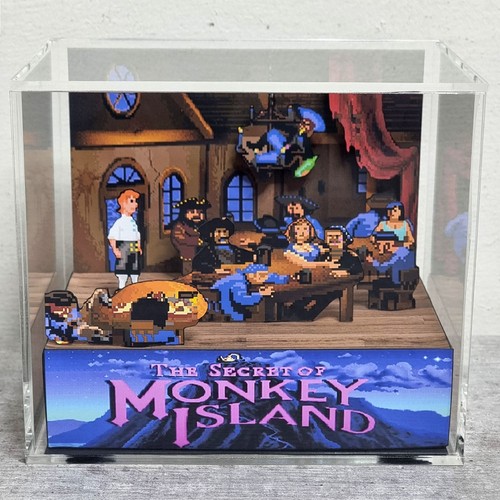 Secret of Monkey Island Diorama Collectible DOS ShadowboxView on eBay »


 ▶Muppet Treasure Island1996MS-DOS / PC


 ▶Bubble Bobble - The Adventure1993ZX Spectrum


 ▶Electro Body1992MS-DOS / PC


