I remember around 1992 firing up this port on my dad's computer with a CGA monitor and thinking: this can't be it. I'd only seen the arcade cabinet in magazine photos back then, but even so, it was clear that the jump from a vector cabinet to a DOS PC was quite a rough landing.
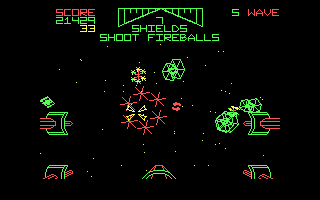
Star Wars: The Arcade Game by Atari originally came out in 1983 — as an arcade cabinet, it was groundbreaking. The DOS port arrived five years later and attempts to bring that same concept to life: you climb into the cockpit of an X-Wing, and your mission is to destroy the Death Star. The whole thing is built on scenes straight from the first film — encounters with TIE Fighters in space, an assault on the Death Star's surface, and the final trench run through the exhaust shaft. No narrative wrapper, no menu packed with options. You just fly and shoot.
The gameplay is split into three phases that repeat at increasing difficulty. The game doesn't exactly welcome mouse or joystick control — the keyboard is essential, and even then it takes a while to find your rhythm. Blasting TIE Fighters is satisfying, and the trench run still has solid drive even today. The biggest problem with the DOS version is the graphics: without the arcade cabinet's vector hardware, you're left with a washed-out imitation that looks like a dotted hallucination on CGA and is barely tolerable on EGA. The sound from the Speaker or basic Sound Blaster doesn't help much either. It doesn't break the game, but you won't find the arcade's magic here.

Still, there's something to it. The 1983 arcade cabinet was technically extraordinary for its time — real-time vector 3D graphics, voices from the film, a precision cabinet shaped like a cockpit. The 1988 DOS port is more of a time capsule from an era when you could port anything to anything because the license allowed it. As a historical artifact, it's interesting. As entertainment software, it has a shorter shelf life than movie popcorn.
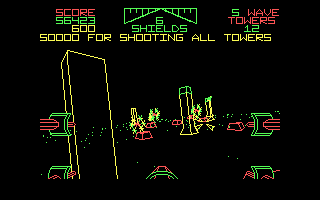
Nowadays you'll play this port mostly out of curiosity or nostalgia for the arcade original. If you're over forty and remember the cabinet, the DOS version will probably disappoint you — your brain remembers the arcade better than reality allows. If you're a Star Wars fan keen to see where the gaming series started, it has its value precisely in that rawness. It's three minutes of fun, then another ten of grinding for an old high score. Which is, honestly, exactly the loop arcades existed for.
 old
 Star Wars Anakin Skywalker T-ShirtView on eBay »
 Star Wars Vintage Collection Darth Vader (The Dark Times)View on eBay »


 ▶Bubble Bobble1989MS-DOS / PC


