Year 1991, a brand new VGA card, and I finally see games in colors that don't look like a disaster at a paint factory. Mah Jongg VGA was exactly the type of game you'd launch "just for a moment" and look up from the monitor only when it got dark outside.
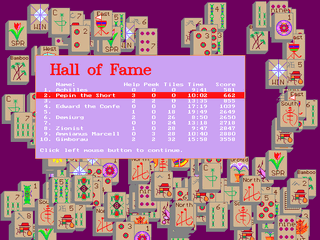
It's a computer take on mahjong solitaire, which spread across the PC world under various names — the most famous being Shanghai by Activision from 1986. The principle stays the same: before you lies a mountain of 144 tiles arranged in the traditional formation, and you gradually remove matching pairs. You can only take tiles if they're uncovered and have at least one free side. Nothing complicated to understand, but you can easily paint yourself into a corner with no way out.
Ron Balewski released it as shareware back then, which meant you'd get the game on a floppy from a friend, play it, and then either buy the full version or just keep playing it over and over without guilt. Mouse controls worked solidly, graphics were decent for 1991 on PC — the VGA palette suited the tiles. Playability is exactly what this genre lives or dies by: either that slowly shrinking mountain of tiles hypnotizes you, or you'll lose interest in twenty minutes and never come back.
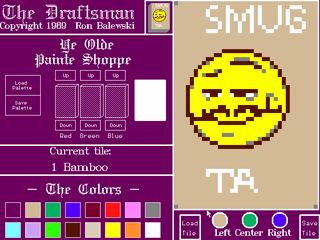
What made this particular title stand out from the competition is hard to say for certain now — back then there were dozens of similar implementations and each one claimed to have better graphics or more formations. Mah Jongg VGA didn't revolutionize the genre, but it did its job honestly. Today the game ages exactly the way this genre ages: the rules are timeless, the interface is period-appropriate but functional. Dead ends are still dead ends and the hints won't hold your hand.
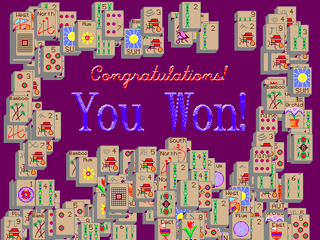
I'd recommend it today to anyone who wants ten minutes of peace and wants to exercise their brain at minimum load — not because it's a pinnacle of gaming history, but because mahjong solitaire just works. You can run it in a browser via DOSBox without installation, without tweaking, without nostalgia being mandatory. Just click and match pairs until the mountain refuses to come apart.
 old

 Worms 2 Diorama Collectible Shadowbox PC Display Retro DOSView on eBay »
 Worms 11.5" Super Sheep Plush w/ SoundView on eBay »






 ▶Chess1998Sega Mega Drive


 ▶Boulder Dash III1986ZX Spectrum


