You wake up in a bathroom of a Chicago bar, your head pounding, a needle mark on your arm, and a gun with spent bullets in your pocket. Bad morning. Worse yet, there's a dead guy upstairs in the office and you can't remember anything — not even who you are.
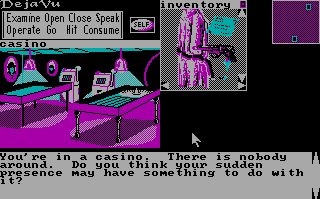
Déjà Vu from 1987 is a noir adventure by ICOM Simulations, one of the first to bring MacVentury mechanics to MS-DOS. The setting in 1930s Chicago underworld isn't just window dressing — this game breathes the detective atmosphere of a cheap paperback, which was rare back then. You're a man without memories, surrounded by evidence stacked against you, and you've got limited time before the cops or someone worse catch up with you.
Controls work through a point-and-click interface with dropdown commands — Open, Examine, Take, Use. By today's standards it looks clunky, but back then it was an elegant system that got around the need to type text commands. Windows for inventory, maps, and scenes stack on top of each other and it takes a while to figure out what goes where. The game doesn't hold your hand. Sometimes you'll die without knowing why. A few puzzles rely on logic that only clicks in hindsight — or on your second playthrough.
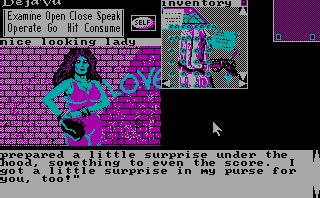
What Déjà Vu delivered was expertly crafted tension rooted in amnesia. You're not solving someone else's mystery — you're piecing together your own identity. That was an unusual approach in 1987 and it still works today. The DOS version's graphics are modest, sound practically nonexistent, but the noir atmosphere holds up without them. What hasn't aged well is that the game sometimes hides crucial items in ways that border on malicious, and death comes without warning. Save often — that's not advice, it's a survival requirement.
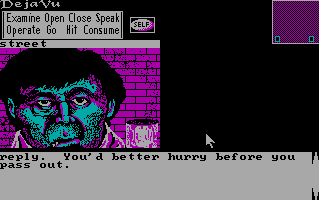
Today Déjà Vu will hook anyone who loves detective stories with real weight to their decisions and who can stomach the game occasionally killing you without mercy for moving in the wrong direction. Play it in your browser at least once — not for nostalgia, but because this is a story most modern adventures can't tell as economically.
 old
 INDIANA JONES SHIRT Safari Raiders Costume HalloweenView on eBay »
 Indiana Jones and the Raiders of the Lost Ark SNES ShadowView on eBay »


 ▶Muppet Treasure Island1996MS-DOS / PC


 ▶Bubble Bobble - The Adventure1993ZX Spectrum


