The box art should have been a warning. A sleek 1930s racer, all curves and chrome, promising something noble — the Mille Miglia, one of the most legendary road races ever run through the Italian countryside. Simulmondo, a Bologna-based studio that churned out licensed titles through the early nineties, had the rights, the history, and apparently very little idea what to do with either.
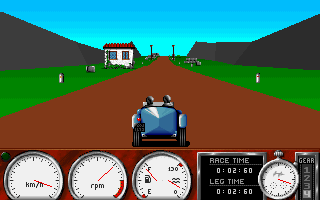
The Mille Miglia itself was a point-to-point road race covering roughly a thousand miles of real Italian roads, run from Brescia and back, with competitors leaving in staggered intervals. The golden era stretched from the late twenties into the fifties, when Ferrari, Alfa Romeo, and Maserati made the public roads their personal circuit. That backstory is genuinely rich. The game, unfortunately, treats it mostly as a coat of paint.
What you actually get is a top-down racer, the kind your 386 could handle without breaking a sweat. You steer a period vehicle through road sections, managing speed and staying on the tarmac. The handling has that particular floatiness common to budget European DOS racers of the era — your car responds like it's being pushed by someone who read a description of physics rather than studied it. The period cars look the part in silhouette, but there's not much depth beneath the surface. No meaningful damage model, no real sense of the mechanical fragility that made the historical race so dramatic.

What it did have, and I'll give it this, was atmosphere in small doses. The setting meant something. This wasn't another anonymous circuit or future city — it was Italy, it was history, and for a kid who had just read something about Nuvolari or Moss, that carried weight. Simulmondo knew how to dress a window. Their other licensed titles from the same period had similar DNA: competent enough to ship, thin enough to forget. 1000 Miglia sits comfortably in that bracket.
It aged the way you'd expect. The mechanical simplicity that felt acceptable in 1992 now feels like an empty room. There's a version of this game that could have been great — proper era-specific car behavior, real route geography, the drama of running on open public roads. None of that made it in. What remained is a curiosity piece, something you load up for ten minutes out of historical interest rather than any genuine desire to keep playing.
If you have a soft spot for early nineties European budget software, or if the Mille Miglia means something to you personally, it's worth a look in the browser just to see how the era handled this kind of license. Go in with the right expectations — think document, not experience — and it won't disappoint you, because you won't be expecting much.
 old
 For 1000 Miglia fans1000 MIGLIA Simulmondo Classic - ITA - PC 3.5" - Very Rare! - Mille MigliaView on eBay »


 ▶Test Drive1987MS-DOS / PC


 ▶F11993Sega Mega Drive


 ▶Micro Machines1994MS-DOS / PC


 ▶Turbo Outrun1989Sega Mega Drive

